

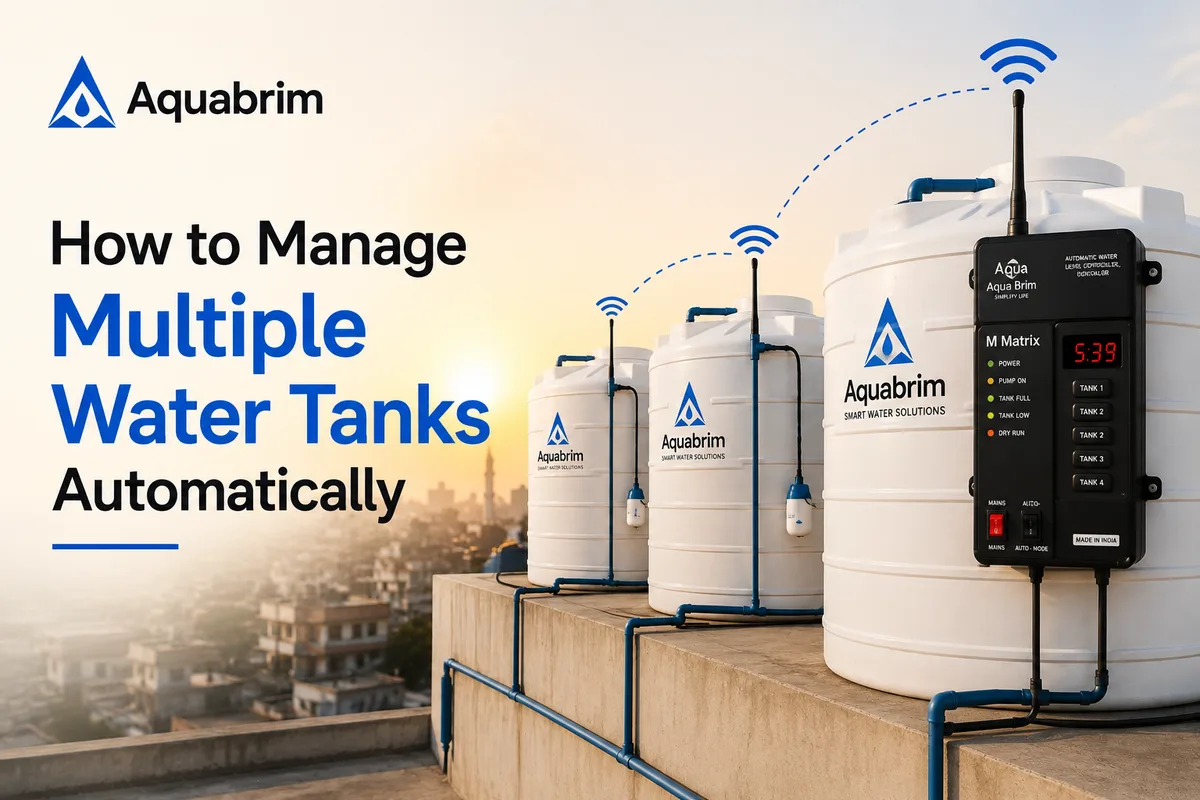
A multi tank water level controller is a system that automatically monitors the water levels in multiple tanks and controls the pumps accordingly — filling each tank when needed and stopping the pump when full. It eliminates manual switching, prevents overflow, protects pumps from dry run, and ensures consistent water supply across all tanks without any human intervention.
If your building has more than one water tank, you already know the problem. Someone has to check each tank, judge when to start the pump, stay alert to stop it before it overflows, and repeat this throughout the day, every day.
In an apartment with three tanks on different floors, or a housing society with tanks across multiple towers, this becomes an almost impossible task to do manually without things going wrong. Water overflows. Some tanks run empty while others are full. The pump runs dry when no one is watching. Electricity bills stay higher than they should.
The solution is a multi tank water level controller — a system that monitors all your tanks automatically and manages pump operation without any human involvement. This guide explains how it works, who needs it, and what to look for before you buy.
Why Managing Multiple Water Tanks Manually Is Difficult
The challenge with multiple tanks is not just volume, it is coordination. Each tank has its own level, its own supply requirement, and its own relationship to the pump and the source. Keeping track of all of this manually, around the clock, is simply not practical.
Here is what typically goes wrong when multi-tank buildings rely on manual management:
- Maintenance staff cannot physically check multiple tanks simultaneously, especially across floors or towers
- Pumps are switched on and off based on guesswork rather than actual tank levels
- Tanks overflow when staff are occupied elsewhere or when the pump is forgotten running overnight
- Some tanks run empty and cause water shortage on specific floors while other tanks are full
- Pumps run dry when the underground sump runs out, leading to expensive motor burnout
- Water and electricity are wasted continuously because there is no precise cutoff point
The more tanks a building has, the more these problems compound. What might be manageable with one tank becomes genuinely chaotic with three or four.
Common Problems Faced in Apartments, Villas and Commercial Buildings
Across India, buildings with multiple tanks face the same set of recurring problems, regardless of whether they are five-storey apartments or large commercial complexes.
Overflowing Tanks
Overflow is the most visible and most common problem. When a pump is not switched off at the right moment, water spills over the top of the tank onto the terrace, down walls, or into the building structure. Over time, this causes seepage, dampness, and in serious cases, structural damage. The water wasted in a single overflow event can be significant, and it happens repeatedly when management is manual.
Uneven Water Distribution
In a building with multiple tanks serving different floors or wings, manual filling often results in some tanks being topped up while others remain at low levels. Residents on certain floors experience low water pressure or shortage while tanks elsewhere are at capacity.
Pump Damage from Dry Run
When an underground sump runs low and nobody notices, the pump continues running without water, a condition called dry run. A motor running dry can burn out within minutes. Replacing a submersible or monoblock pump is an expensive, time-consuming repair that is entirely avoidable with the right level of monitoring.
Higher Electricity Bills
Pumps running longer than necessary, because no one switched them off at the right time, contribute directly to higher electricity consumption. In large buildings with high-capacity pumps, even a few extra hours of daily pump runtime adds up to a significant monthly cost.
Maintenance Cost and Manpower Dependency
Manual water management in multi-tank buildings requires dedicated maintenance staff. This represents an ongoing cost and a dependency that creates problems during staff absences, shift changes, and night hours when no one is on duty.
What Is a Multi Tank Water Level Controller?
A water level controller is a system that uses sensors to measure water levels and automatically controls pumps based on those readings. A multi tank version extends this capability to handle several tanks simultaneously from a single control unit.
The system consists of three main components working together:
- Sensors — placed inside each tank (and usually in the underground sump as well), these measure the current water level continuously and send that data to the controller
- Control unit — receives level data from all sensors and makes decisions about when to start and stop the pump, based on pre-set upper and lower thresholds for each tank
- Pump interface — the controller connects to the pump's power supply and switches it on or off automatically based on the instructions from the control logic
In a wireless system, the sensors communicate with the control unit over radio signal, so no cables are needed between the tanks and the controller. This is particularly important in multi-storey buildings where running cables across floors and through walls would be expensive and invasive.
The key difference between a single-tank controller and a multi-tank system is the ability to coordinate across multiple tanks simultaneously: prioritising which tank fills first, managing the pump to avoid overloading, and ensuring every tank in the building maintains adequate water levels.
How Automatic Multi Tank Controllers Work
The process is straightforward once you understand the logic. Here is how a typical multi tank controller operates, step by step:
- Tank level detection — the sensor in each tank reads the current level continuously
- The controller receives the sensor data from every tank and from the sump
- The pump turns ON automatically for whichever tank needs filling next
- The tank fills to its target level while the controller monitors progress
- The pump turns OFF automatically the moment that target level is reached
In practice, the system runs this cycle continuously for each tank in the building. The controller checks the levels of all tanks and the sump, determines which tank needs filling next based on priority settings, activates the pump, monitors the fill progress, and stops the pump when the tank reaches its target level.
If the sump level drops too low during this process, the controller stops the pump immediately, before dry run can cause motor damage, and waits until the source replenishes.
All of this happens automatically, without any manual input. The wireless water level controllers that use app connectivity also send real-time alerts to a mobile device if any tank drops below a warning level, or if the pump has been running longer than expected.
Benefits of Automating Multiple Water Tanks
The shift from manual to automatic management produces measurable improvements across water use, electricity consumption, pump lifespan, and maintenance workload. Here is the full comparison:
| Benefit | Without a controller, and with a multi tank controller |
|---|---|
| Overflow prevention | Without: tanks overflow regularly, wasting water and causing seepage damage. With: the controller stops the pump automatically when a tank reaches its full level. |
| Water wastage | Without: hundreds of litres lost monthly to overflow. With: near-zero overflow, every litre goes where it should. |
| Electricity bills | Without: the pump runs longer than needed, wasting electricity. With: the pump runs only as long as required, so monthly bills drop. |
| Pump protection | Without: dry run goes undetected and the motor burns out. With: dry-run cutoff stops the pump before damage occurs. |
| Water distribution | Without: some tanks overfill while others run empty. With: balanced, prioritised filling across all tanks. |
| Manpower needed | Without: someone must check levels and switch pumps manually. With: fully automatic, zero manpower for routine operation. |
| Remote monitoring | Without: no visibility, problems are found only after they occur. With: app-based alerts give real-time status from anywhere. |
The financial case for automation is straightforward: the cost of a quality multi tank controller is typically recovered within the first year through reduced water wastage, lower electricity bills, and avoided pump repair costs.
Who Needs a Multi Tank Water Level Controller?
Any building or facility with more than one water tank will benefit from automation. Here is a breakdown by building type:
| Building type | Typical tank setup and why automation matters |
|---|---|
| Apartments (5+ floors) | 2–4 overhead tanks plus an underground sump. Multiple floors need consistent pressure, and manual management fails quickly. |
| Housing Society / RWA | 4–10+ tanks across multiple towers. One staff member cannot manually manage multiple buildings effectively. |
| Villas / Bungalows | 2–3 tanks (main, garden and backup). Owner-managed properties benefit most from hands-free automation. |
| Hotels & Resorts | 5–15 tanks across floors and wings. Guest experience depends on uninterrupted water, so manual is too unreliable. |
| Hospitals | 6–20 tanks (sterile, general and fire). Water continuity is a safety requirement, so automation is non-negotiable. |
| Schools & Colleges | 2–5 tanks across blocks. Water shortage during peak hours causes serious operational disruption. |
| Factories & Industries | 10–50+ tanks across zones. Industrial operations cannot afford manual water management at scale. |
| Commercial Buildings | 3–8 tanks across floors. Facility managers need centralised control, not manual floor-by-floor checks. |
The common thread across all of these is that manual management creates a dependency on human attention that is simply not sustainable, particularly at night, during peak demand hours, or when staff are unavailable. Automation removes that dependency permanently.
Choosing the Right Multi Tank Water Level Controller
Not all multi tank controllers are equal. Before purchasing, work through these eight factors:
| Factor | What to check, and why it matters |
|---|---|
| Number of tanks | How many tanks does the system need to manage? The controller must support your current count, and ideally more, for future expansion. |
| Wireless range | What is the maximum distance between the tanks and the control unit? The wireless range must cover the full site without signal loss. |
| Scalability | Can more tanks be added later without replacing the system? Scalable systems grow with the building; non-scalable ones become obsolete. |
| Dry-run protection | Does it monitor the source (sump or borewell) as well as the tanks? Without source monitoring, pumps burn out when the supply runs low. |
| Overflow protection | Does it stop the pump before the tank overflows? Overflow causes water wastage and structural damage, basic but essential. |
| Remote monitoring | Can you monitor levels and get alerts from a mobile app? Essential for facilities where the control room is not next to the tanks. |
| Installation complexity | Does installation require cabling between tanks? Wireless systems save significant installation cost in large buildings. |
| Brand and warranty | Is after-sales support available, with a minimum one-year warranty? Multi-tank systems in large buildings must have reliable service backup. |
The most common mistake buyers make is choosing based on price alone. A controller that lacks dry-run protection or overflow cutoff may seem cheaper upfront but will cost significantly more over time through pump repairs and water wastage.
Why Aquabrim Matrix Is Built for Multi Tank Management
Aquabrim has been building water management systems for Indian homes, apartments, and industries since 2008. The Aquabrim Matrix Multi Tank Water Level Controller is the company's dedicated solution for buildings that need to manage more than one tank from a single automated system.
Here is what the Matrix is designed to do:
- Multiple tank support — the Matrix manages several tanks simultaneously, coordinating pump operation across all of them from one central controller
- Wireless operation — sensors communicate with the control unit over radio signal, so no cables are required between tanks and the controller, even across floors or buildings
- Automatic pump control — the pump starts and stops based on actual tank levels, not manual judgment, eliminating the most common cause of overflow and dry run
- Overflow protection — the controller stops the pump the moment any tank reaches its full level, preventing water wastage and terrace flooding
- Dry-run protection — the system monitors the source water level as well as the tanks, so if the sump runs low the pump stops automatically before motor damage can occur
- App-based monitoring — connect to the Aquabrim platform for real-time tank level visibility, motor status updates, and alerts from any device
- Easy installation — the wireless design means sensors can be placed in tanks without running cables back to the control unit, reducing installation time significantly
- Reliable performance — built for Indian operating conditions, designed to handle voltage fluctuations, hard water environments, and variable supply schedules
If you are looking for a reliable way to automate multiple water tanks, explore the Aquabrim Matrix Multi Tank Water Level Controller and see how it simplifies water management for homes, apartments, and commercial buildings. You can also view all wireless water level controllers.
Conclusion
Managing multiple water tanks manually is not just inconvenient, it is expensive, unreliable, and ultimately unsustainable for any building that needs consistent water supply. A multi tank water level controller replaces manual judgment with automatic precision: every tank fills when it should, the pump stops the moment it should, and nothing overflows or runs dry.
For apartments, housing societies, commercial buildings, hospitals, and industrial facilities across India, the case for automation is straightforward. The technology is available, the installation is simple, and the returns, in saved water, saved electricity, and avoided repairs, arrive quickly.
If your building has more than one tank and water management is still a daily manual task, automation is the logical next step. Read next: why every home needs a smart water level controller.
Ready to stop manually managing your tank?
Aquabrim makes smart water level controllers for every home setup, municipal supply, borewell, or multiple tanks. Trusted by 50,000+ homes across India.
FAQ
Frequently Asked Questions
A multi tank water level controller uses wireless sensors placed inside each tank to measure the water level continuously. These sensors send readings to a central control unit, which automatically turns the pump on when a tank falls below a set level and turns it off when the tank is full. The system manages multiple tanks simultaneously, ensuring each fills in the correct sequence without overflow or dry run.
Yes. A multi tank controller is specifically designed to manage more than one tank from a single control unit. Depending on the system, it can handle two, four, or more tanks and coordinate pump operations across all of them. The control logic ensures tanks are filled in a prioritised sequence rather than all at once, which protects the pump and prevents supply imbalance.
For most apartments, housing societies, and commercial buildings, yes. Wired systems require cables to run between every sensor and the control unit, which in multi-storey buildings means significant installation work, wall cutting, and conduit running. Wireless systems use radio signals between sensors and the controller, eliminating that installation burden entirely. They are easier to install, easier to maintain, and equally reliable.
Yes, and they benefit most from them. Apartments and housing societies typically have multiple tanks across multiple floors, with pump management often assigned to maintenance staff who cannot be present continuously. An automatic multi tank controller removes the dependency on manual operation entirely, so the system manages itself around the clock, regardless of whether staff are present.
Yes. Manual pump operation tends to leave pumps running longer than necessary, either because no one is watching the tank level, or because someone forgets to switch off. An automatic controller stops the pump the moment the tank reaches its full level. Over a month, this reduction in unnecessary pump runtime translates to a measurable reduction in electricity bills, particularly in large buildings with high-capacity pumps.
For wireless systems, installation is straightforward. The sensors clip inside each tank and communicate wirelessly with the control unit, which connects to the pump's power supply. No cables need to run between tanks and the controller. In most residential and commercial installations, a qualified electrician can complete the setup in a few hours. Wired multi-tank systems take longer due to cable routing but are still a standard installation task.
A good multi tank controller includes dry-run protection. This means the system monitors the source, the underground sump or borewell, as well as the overhead tanks. If the source water level drops below a safe threshold, the controller stops the pump automatically before it can run without water. This protection is essential for buildings on borewell or inconsistent municipal supply.